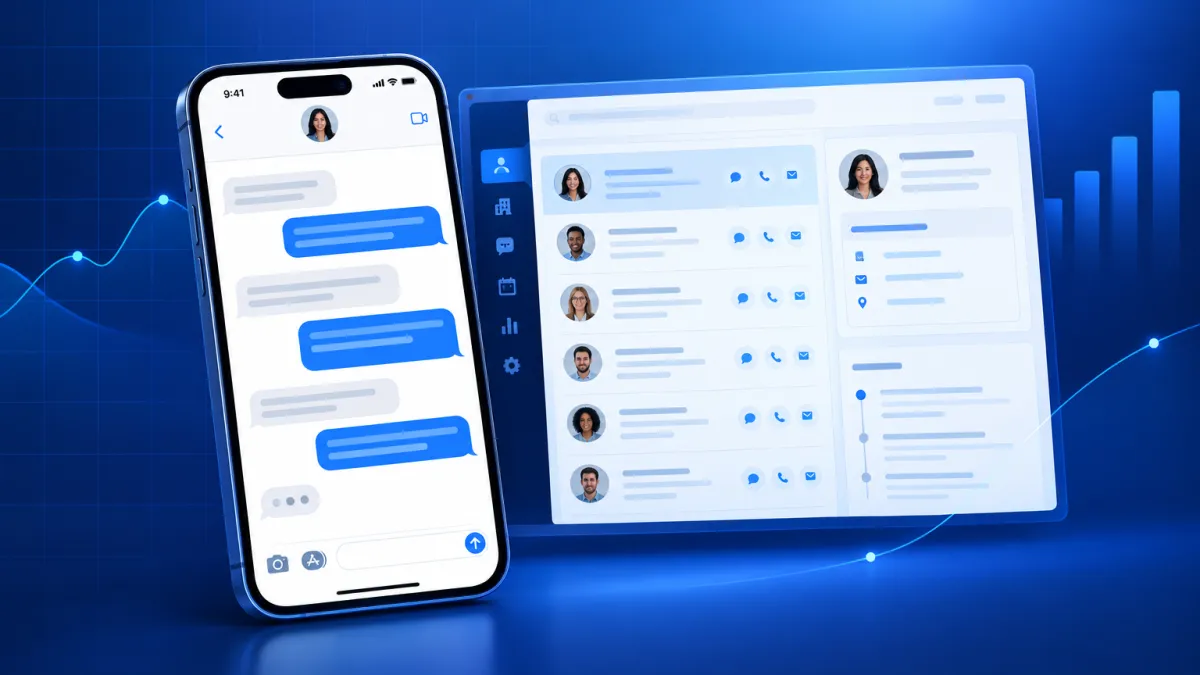
Most CRM teams are still sending green-bubble SMS to follow up with leads — and quietly losing reply rates they never knew they had. The color of a text bubble is not a cosmetic detail. It is a signal that determines whether a lead reads your message, replies to it, or ignores it entirely.
In 2026, the gap between blue-bubble messaging and standard business SMS has become one of the clearest, most measurable differences in CRM follow-up performance. This post breaks down what that difference actually means, why it matters for your pipeline, and what to look for in a blue-bubble texting tool that works natively inside your CRM.
What Is Blue-Bubble Texting?
Blue-bubble texting refers to sending messages through Apple's iMessage network rather than standard carrier SMS. If you use an iPhone, you already see this every day: messages to other iPhone users appear in blue bubbles, while messages to Android users — or messages sent through business SMS platforms — appear in green.
That color distinction carries real psychological weight. Years of consumer behavior have trained iPhone users to associate blue bubbles with personal, trusted conversations and green bubbles with marketing, automation, and spam. For CRM teams whose entire pipeline depends on getting replies, that distinction is not trivial.
Blue-bubble business messaging platforms provision dedicated phone numbers registered to the iMessage network. When a lead with an iPhone receives your outbound message, it arrives looking exactly like a text from a friend — because, from the iPhone's perspective, it is. For Android recipients, a well-built platform automatically falls back to RCS or SMS so no one is missed.
Blue Bubbles vs. SMS: The Numbers in 2026
The engagement gap between blue-bubble messaging and standard SMS has grown substantially as carrier A2P filtering has become more aggressive. Here is what the current data shows:
| Metric | Blue-Bubble (iMessage-Style) | Standard Business SMS |
|---|---|---|
| Open Rate | 95–98% | 18–22% |
| Response Rate | 30–45% | 5–10% |
| Delivery Rate | 99%+ (to iMessage-enabled numbers) | 75–85% (due to A2P carrier filtering) |
| Read Receipts | Yes | No |
| Carrier Spam Filtering | Bypassed (Apple's network, not carriers) | Increasing — 10DLC enforcement is ongoing |
| A2P Registration Required | No | Yes (10DLC for standard business SMS) |
| Rich Media Support | Full resolution images, video, documents | Compressed MMS only |
Note: Engagement benchmarks reflect vendor-reported and industry-aggregated data from 2026. Individual results vary by audience, content, and sending patterns. Verify key metrics with your own send data before projecting pipeline impact.
The delivery gap is particularly important. Carrier SMS filtering under A2P 10DLC compliance enforcement has made it harder to reliably reach leads through standard business texting channels. iMessage bypasses carrier networks entirely — your message travels over Apple's servers, not AT&T's or T-Mobile's, which means it arrives exactly as sent.
Why the CRM Integration Matters More Than the Bubble Color
Here is what most blue-bubble platform comparisons miss: the messaging channel is only half the story. The other half is whether that channel is actually connected to your CRM in a way your team will use.
Most blue-bubble tools in the market today are built API-first — designed for developers who want to build custom integrations. They offer REST APIs, webhooks, SDKs, and sandbox environments. That is powerful if you have an engineering team. If you have a sales team, it creates a workflow problem.
CRM teams need blue-bubble messaging to work the way their CRM already works:
- Conversations triggered by lead status changes, form fills, or pipeline stages — not by developer-built scripts
- Replies that land directly on the contact record — not in a separate inbox your reps have to check
- Follow-up sequences that pause when a lead replies — so you are not sending automated texts into an active conversation
- Read receipts that are visible inside the CRM — so reps know when to call, not just when to guess
This is the gap that developer-focused blue-bubble platforms leave open. Sendblue, for example, positions itself primarily as an API product — setup requires developer work, and the standalone web interface has received mixed reviews for usability by non-technical sales reps. Blooio is similarly API-first, with its more accessible pricing tiers limited to shared numbers with strict daily contact caps (as low as 5 new contacts per day on the $39/month tier, based on publicly available pricing data from May 2026).
For CRM-driven teams — real estate professionals, agencies, home service businesses, insurance producers, and inside sales teams — the right blue-bubble solution is one where conversations live inside the CRM, not alongside it.
What to Look For in a Blue-Bubble CRM Texting Tool
Not all blue-bubble platforms are created equal. Before choosing a tool, evaluate it against these criteria:
1. Native CRM Integration (Not Just API Access)
Does the platform connect directly to your CRM without requiring developer setup? Can your sales reps trigger and receive blue-bubble messages from inside their existing workflow? Native integration means conversations sync back to contact records automatically — without Zapier glue or custom middleware holding it together.
2. Dedicated Phone Numbers
Shared phone numbers — where multiple businesses share one iMessage line — create deliverability and trust risks. Leads who reply to a number they have texted before, only to receive a response from a different company's rep, will notice. Dedicated numbers tied to your business build recognition and conversation continuity.
3. Intelligent Fallback for Android Users
iMessage only reaches Apple devices. A well-built platform detects whether a number is iMessage-enabled and automatically falls back to RCS (for Android users on supported carriers) or SMS. This ensures no leads are left unreachable due to device type.
4. Conversation Visibility Inside the CRM
If your reps have to log into a separate portal to read replies, adoption will be low. Blue-bubble conversations should appear on the lead's contact record in your CRM — the same place reps are already working.
5. Compliance Awareness
iMessage outreach follows the same TCPA consent principles as any other text messaging program. Prior express consent is required for marketing messages. A blue-bubble platform should support opt-out handling and should not encourage practices that conflict with your compliance obligations. Consult your legal counsel for guidance specific to your use case and industry.
6. Practical Pricing for Sales Volumes
Evaluate total cost at your actual expected volume. Some platforms advertise low entry prices that apply to inbound-only or shared-number tiers, with dedicated outbound lines priced significantly higher. Read the fine print on what each tier actually includes before committing.
The Real-World Impact: Lead Response and Pipeline Velocity
The business case for blue-bubble CRM texting is clearest in industries where lead response speed drives pipeline outcomes — real estate, home services, insurance, and agency lead generation.
Consider a simple scenario: a team sending 500 monthly follow-up messages to fresh leads. At a 5–10% SMS reply rate, that yields 25–50 replies. At a 30–45% blue-bubble reply rate, the same 500 messages produce 150–225 replies. That is not a marginal improvement in a dashboard — it is a meaningful change in how many conversations your team is actually having with leads each month.
Read receipts add another layer of value. When reps know a lead has read a message — without a reply — they have the context to make a timely follow-up call rather than sending a redundant second text or waiting indefinitely.
These outcomes compound over a full quarter. More conversations mean more booked appointments. More appointments mean more closed deals. The channel change cascades into pipeline velocity.
How Leadengage Blue Approaches This Differently
Leadengage Blue is built for CRM teams, not engineering teams. The platform connects to your CRM so your team can send blue-bubble-style messages directly from inside their existing workflow — without developer setup, without separate portals, and without conversations disappearing into an inbox no one checks.
Conversations stay on contact records. Replies surface where reps are already working. Follow-up sequences are CRM-native. And because Leadengage Blue integrates at the CRM layer rather than the API layer, the setup time measured in hours, not sprints.
For teams in real estate, home services, agencies, and sales-heavy businesses where every lead reply is a pipeline event, that difference in how the tool is built translates directly into whether the team actually uses it.
Frequently Asked Questions
What is blue-bubble texting for business?
Blue-bubble business texting sends messages through a dedicated phone number registered to the iMessage network. Recipients on iPhones see the message as a blue bubble — the same visual format as a personal text — rather than a green SMS bubble associated with automated business messaging.
Does blue-bubble texting require A2P 10DLC registration?
No. A2P 10DLC registration applies to messages sent over US carrier networks (SMS/MMS). iMessage travels over Apple's servers, not carrier networks, so A2P registration requirements do not apply. TCPA consent obligations still apply to any outbound texting program regardless of channel.
What happens when a lead has an Android phone?
A well-built blue-bubble platform automatically detects whether a number is iMessage-enabled and falls back to RCS or SMS for Android recipients. No leads are missed due to device type.
What are the response rate differences between blue bubbles and SMS?
Industry benchmarks for 2026 report blue-bubble reply rates in the 30–45% range, compared to 5–10% for standard business SMS. Open rates for blue-bubble messages range from 95–98%, compared to 18–22% for SMS marketing. Results vary by audience, message content, and sending patterns.
Do I need a developer to set up blue-bubble CRM texting?
That depends on the platform. API-first tools like Sendblue and Blooio are designed for developer integration. CRM-native tools like Leadengage Blue are designed for sales teams and do not require developer setup.
Are blue-bubble texts TCPA compliant?
iMessage outreach follows the same TCPA consent principles as any other text messaging program. Prior express consent is required for marketing messages. Consult your legal team for guidance specific to your use case, industry, and message type.
What is the difference between a shared and a dedicated iMessage number?
A shared number is used by multiple businesses on the same platform tier. A dedicated number is exclusively assigned to your business, preserving conversation history, contact recognition, and deliverability integrity across your outreach.
The Bottom Line
The blue-bubble vs. SMS debate is settled in 2026. Blue-bubble messaging consistently delivers higher open rates, higher reply rates, and better deliverability than standard business SMS — and the gap is growing as carrier filtering makes SMS less reliable.
The more important question is not whether to use blue-bubble messaging, but which platform is actually built for how your CRM team works. API-first tools serve developers. CRM-native tools serve sales teams. If your reps are the ones following up with leads every day, the platform they use should work the way they work — not require them to change workflows to accommodate the technology.
Ready to see how blue-bubble-style messaging works inside a CRM built for your team? Book a demo with Leadengage Blue and see what your reply rates could look like with conversations that feel like real texts.
